

Get to know the place
History and identity
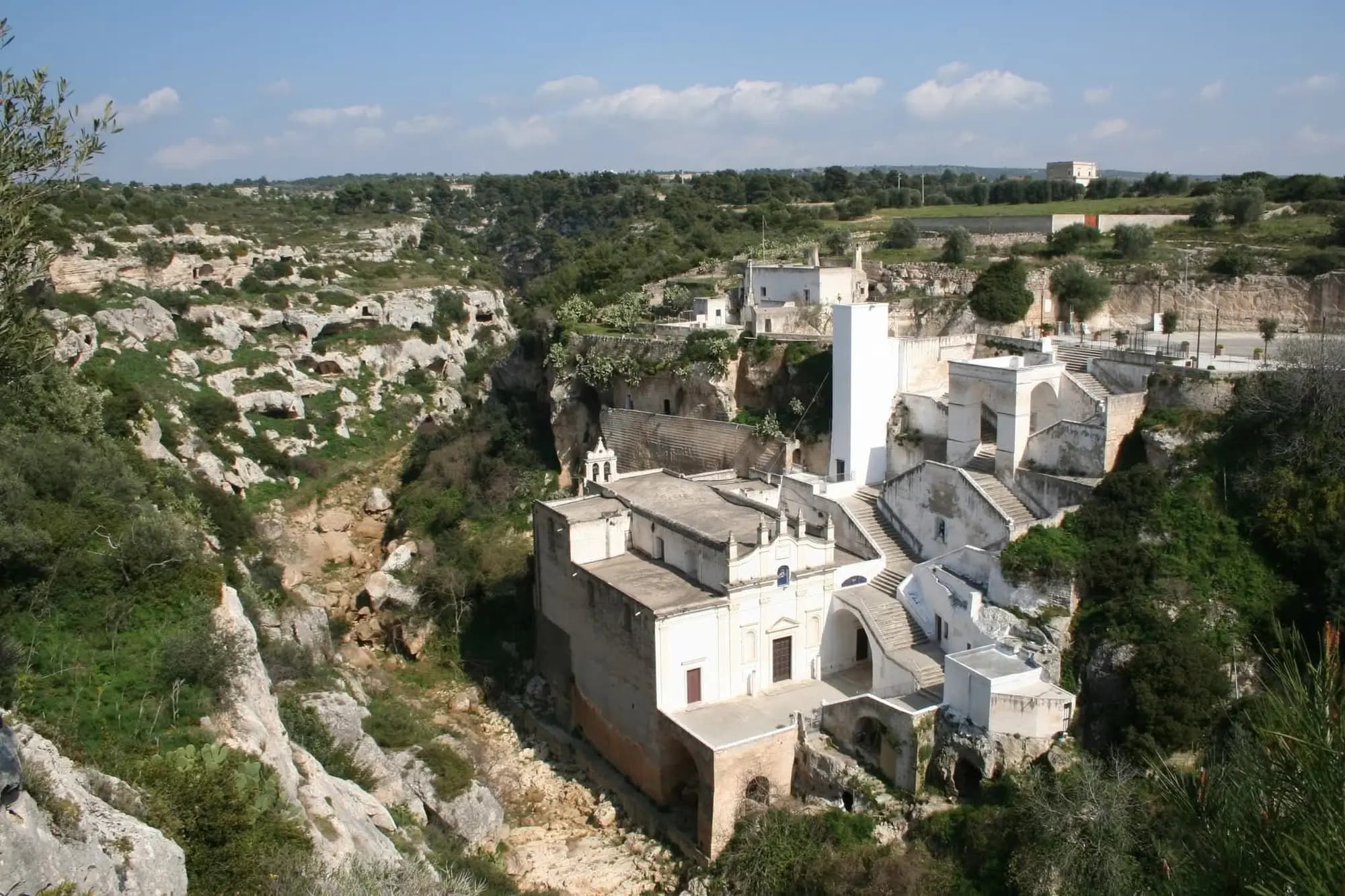
The sanctuary does not stand on top of anything: it stands inside the gravina – the karst ravine – clinging to its eastern side, where the rock opens up and the town ends in empty space. You reach it by going down a Baroque staircase of 127 steps through the Valle delle Rose. It is the historic route, and it is still the one the people of Massafra take.
The miracle of the hind
The devotion springs from a story: two hinds chased by hunters stopped and knelt before an image of the Virgin hidden among the rocks. Tradition places the episode around the 14th century and traces everything back to it – the name, the pilgrimage, the church.
At the centre of the 18th-century high altar, on a block of limestone, that fresco is still there: a 12th-century Madonna in the Byzantine manner, with a dark face and a steady gaze. It is not a museum piece put there to be looked at: it is the reason the building exists, and the church was built around it.
A church built against the rock
Work began in 1729 over an older chapel, and the church opened for worship in 1737. It has a Latin-cross plan, with three barrel-vaulted naves, in a style that moves from Baroque to neoclassical. Since 1776 the Madonna della Scala has been the principal patron saint of Massafra: 2026 marks 250 years of that patronage.
The gravina around it
The Gravina della Madonna della Scala is almost four kilometres long, about forty metres deep and between thirty and fifty metres wide. It changes name three times along its course: Corno della Strega to the north, Valle delle Rose in the central section, Capogravina to the south. Around six hundred plant species live there, many of them rare and several with medicinal properties.
A rock-cut village opens up on its walls: over two hundred dwellings carved into the calcarenite, inhabited until the 12th century. Among the best-known caves are the Grotta del Ciclope and the so-called Farmacia del Mago Greguro (Wizard Greguro’s Pharmacy), a complex of twelve interconnecting rooms with around a hundred identical niches carved into the wall: in popular lore, they were a herbalist’s shelves.
How to visit
The church can be visited freely during opening hours. The gravina and the rock-cut village cannot: the paths are exposed and the heritage is fragile, so they can only be explored with a guide, on excursions that must be booked in advance.
Images
Gallery
Checked information
Accessibility of the place
Conditions are described concretely, to help you plan your visit.
One hundred and twenty-seven stone steps link the town to the churchyard. It is the historic route and has no sloping alternative: anyone who does not feel up to the steps must arrive by road.
The sanctuary can also be reached by car from Via del Santuario, avoiding the staircase altogether.
Uneven surfaces, sloping sections and exposed passages. The Comune advises people with mobility difficulties against the excursion; the full visit takes about three hours.
Access conditions inside the church have not been checked in person. Before setting off, it is best to phone the sanctuary and ask.
- The sanctuary is a working church: during services, visits may be suspended or limited. The times below are those given by the sanctuary, but a phone call before setting off will settle any doubt.
- Do not enter the gravina on your own. The paths are exposed, the caves are fragile and several areas are not safe.
- Guided excursions in the gravina must be booked at least two days in advance and go ahead only with a minimum of ten participants.
On site
Services
- Daily services
- Guided tours of the gravina and the rock-cut village, by booking
- Starting point for routes through the rock-cut village
Sources
- Santuario della Madonna della Scala — sito ufficiale (opens in a new tab)
- FAI — I Luoghi del Cuore: Santuario Madonna della Scala (opens in a new tab)
Information last checked: .