

Get to know the place
History and identity
In the heart of Massafra’s old town, in the quarter known as “U’ Bommin”, stands the Santuario di Gesù Bambino, one of the town’s most unusual places of worship.
Its story begins with a small wax figure of the Christ Child, which in the 19th century became the object of intense popular devotion and the focus of a series of events held to be miraculous.
A story of devotion and wonders
The story is linked to the noblewoman Isabella Accolti Gil, wife of Francesco Broia of Massafra. According to tradition, the figure, bought a few years earlier and placed in the family’s nativity scene, first showed miraculous phenomena on Christmas night 1846.
The phenomena are said to have recurred in the following years. In 1849 the figure was reported to sweat and to move its eyes and limbs; on 2 February 1850 traces of blood are also said to have appeared on its chest. Isabella’s devotion was also credited with the healing of her husband, who had suffered a severe haemorrhage.
The fame of the Bambinello spread quickly. The figure was first displayed in the Chiesa Madre so that the people could venerate it, and the growing devotion led to the decision to build a church to house it.
The story was told by Isabella Accolti Gil herself in an 1850 publication entitled Relazione sull’origine, manifestazioni, e miracoli del Bambino Gesù (Account of the origin, manifestations and miracles of the Christ Child), a valuable record of how the cult was born and spread.
The birth of the sanctuary
In 1850, with the authorisation of King Ferdinand II, construction began on the new church dedicated to the Christ Child.
The design was entrusted to the architect Sante Simone, from Conversano, who also designed the adjoining friary. The church was completed and opened for worship on 7 November 1858 by the Bishop of Castellaneta, Monsignor Bartolomeo D’Avanzo.
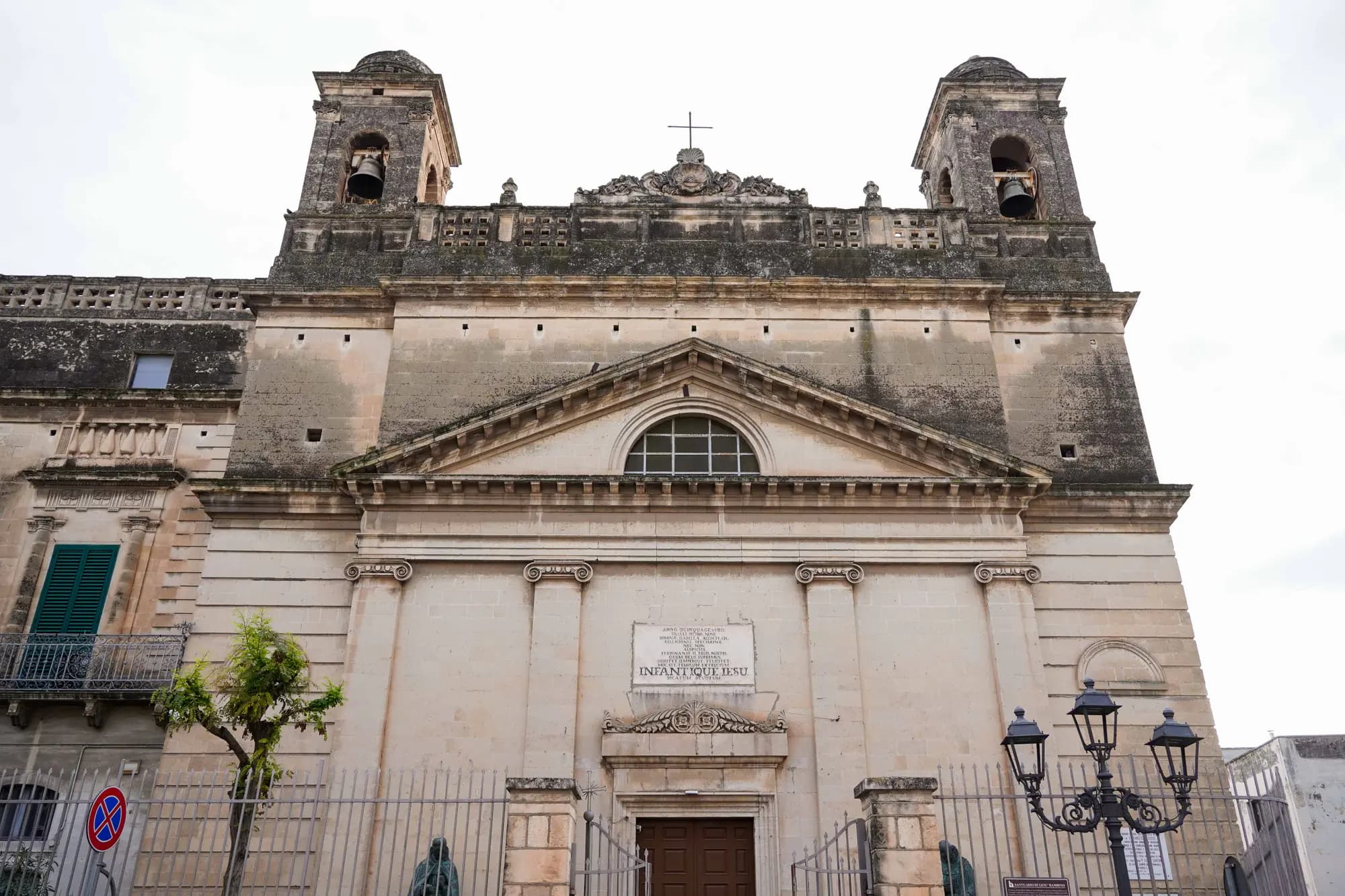
Recalling the origin of the church, a marble inscription on the façade celebrates the devotion of Isabella Accolti Gil and the protection granted to the building by the king:
In the fiftieth year of the nineteenth century, as proof of the piety of Donna Isabella Accolti Gil and under the auspices of our King Ferdinand II, this church was built and dedicated to the Christ Child.
In 1945 the church became a parish and in 1956 it was raised to the status of Sanctuary.
Neoclassical architecture
The façade, in an elegant neoclassical idiom, is arranged on two levels and has a central section articulated by large pilasters and topped by a pediment. On either side rise two small bell towers crowned with small domes.
The interior consists of a single apsed nave flanked by four side chapels. The proportions of the hall and the particular shape of the vault have been likened to the symbolic form of an upturned cradle, a reference to the central place of the Christ Child in the design of the church.
The Bambinello
The heart of the sanctuary is the small wax figure of the Christ Child, kept in a precious silver case.
On its head is a gold crown, donated by Cardinal Benedetto Aloisi Masella for the celebrations marking the centenary of the miracles, in 1950.
It is this small image, fragile and precious, that gives meaning to the whole building: the sanctuary was in fact built to keep an object of devotion that has become, over time, a symbol of the faith and religious memory of the Massafra community.
Isabella Accolti Gil and the memory of the foundation
Behind the altar are the tombs of the benefactress Isabella Accolti Gil and her administrator, the notary Ignazio Scarcia.
Their portraits, painted in 1870 by the Massafra painter Nicola Galeone, are kept in the sacristy. Their images inside the sanctuary keep alive the memory of those who played a leading part in the birth of this place of worship.
The friary and the works of art
A friary for the religious community was attached to the church. The complex was entrusted to the Frati Minori (Friars Minor), who helped preserve and enhance the artistic heritage, including works from other places of worship in the town.
The sanctuary in fact holds canvases dating from the 17th to the 19th century, some of them from the old Capuchin friary.
The complex also preserves a decorative and artistic heritage that bears witness to the continuity of devotion over the centuries.
A sanctuary in underground Massafra
The Santuario di Gesù Bambino stands in the heart of one of the town’s historic quarters, in an area marked by the “vicinanze” (shared courtyards): old open-air and underground quarries transformed over time into homes and living spaces.
Here the sanctuary’s 19th-century architecture is in dialogue with the town’s oldest fabric: alleys, houses, cavities and paths that tell of the special relationship between the Massafra community and the rock.
In 2008, on the initiative of the sanctuary community, a photographic exhibition and the Museo dei Divini Prodigi (Museum of Divine Wonders) were opened, devoted to the history of the figure and to the memory of the devotion that grew up around it.
Five places in Europe
The Santuario di Gesù Bambino in Massafra is traditionally described as one of the five churches in Europe dedicated to the Christ Child, a feature that underlines its particular importance in the landscape of European devotion.
A small figure, a great story of faith: in Massafra the Christ Child continues to keep the memory of a community and of a devotion born almost two centuries ago.
Images
Gallery
Sources
Information last checked: .