

Get to know the place
History and identity
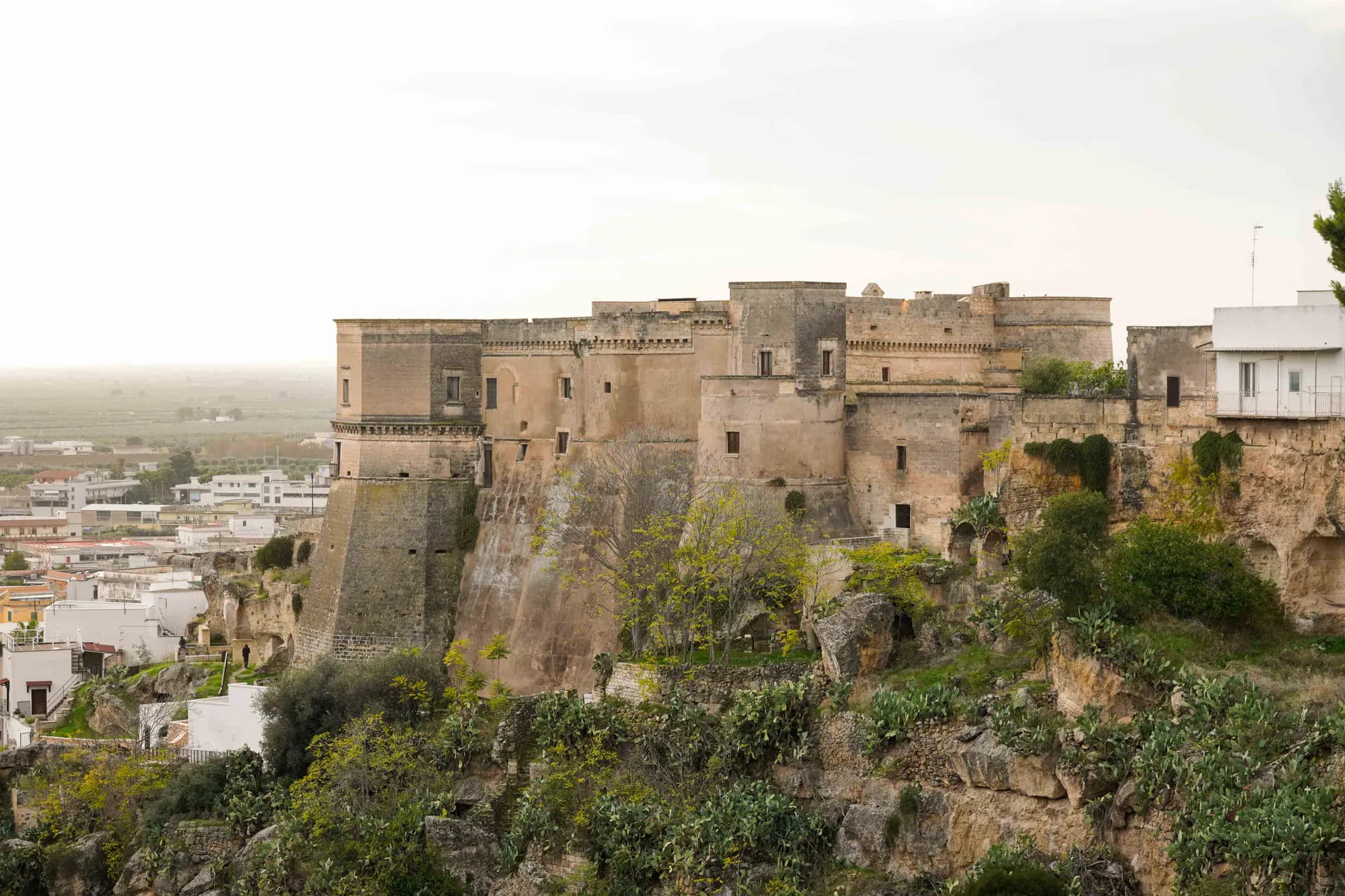
Perched on the edge of the spectacular Gravina di San Marco – a gravina, or karst ravine – the Castello di Massafra is one of the most striking fortresses in Apulia, an exceptional witness to centuries of feudal history and architectural change. It stands on a high rocky spur historically known as “lo Pizzo”. This strategic, commanding position gave complete visual control over the rock-cut settlement below and over the main routes linking Taranto with the inland Murge.
Historical development
The earliest documentary evidence of a fortified settlement in Massafra dates from the 10th century, in a judicial record of 970 AD. Later, under Norman-Swabian rule, a true fortress was probably built – although there is no archaeological evidence for this – and the building took on a strategic role of the first importance, set on the edge of the deep gravina. It was in the Angevin period that the castle was rebuilt for better defence and assigned over time to various feudal lords, among them Charles I of Anjou, who granted it to Oddone di Soliac.
In the 15th century the castle was extensively rebuilt by the Pappacoda, a powerful Neapolitan patrician family that held the fief of Massafra for about a century and a half. They carried out the modernisation works and strengthened the bastions, made necessary by developments in the warfare techniques of the time.
In 1782 the property passed to the Imperiali, a wealthy and influential Genoese feudal house. The Imperiali undertook a major architectural project, commissioning the striking octagonal tower facing south-east, with a panoramic and defensive view over the Gravina di San Marco.
With the end of the feudal system, the royal domain sold the castle to a wealthy local landowner, Michelangelo Zuccaretti. On his death in 1859, the castle passed by will to the Ospedale dei Pellegrini in Naples.
It was later bought by the Serini family, its last private owners before it passed permanently to the Comune di Massafra (the municipality), which restored it and made it the town’s cultural centre.
Architecture and spaces
The structure keeps the classic quadrilateral plan bounded by four towers: three round ones and the octagonal tower to the south-east.
The entrances: the main portal on via La Terra leads into the Piazza d'Armi, where a ramp leads up to the inner courtyard (once protected by a drawbridge, whose stone pulleys can still be seen). In 1870 the secondary entrance from via Lopizzo was opened, when the castle housed schools and private homes.
The piano nobile: reached by a monumental staircase and featuring pointed arches, it housed the lord’s residence and the small frescoed oratory dedicated to St Anthony of Padua.
Lower floors and underground levels: working and storage areas including stalls, horse stables, storerooms, prisons, the neviera (snow store) and the peceria, used for storing pitch.
The Cappella di San Lorenzo Martire: located in the courtyard, it can be recognised by the Latin inscription DIVO LAURENTIO INSTAURATUM.
Stories, legends and present use
Between myth and mystery: popular tradition tells of a dense network of secret underground tunnels that allowed escape all the way to the sea in case of siege, and of the dreaded “Sala del Muta Pensiero”, the fortress’s old torture chamber.
Today, duly restored and enhanced by the Comune, the castle’s rooms live on as a place of culture and a keeper of local roots, housing the Biblioteca Comunale (municipal library) and the “Civico museo storico-archeologico della civiltà dell'olio e del vino” (civic museum of the history and archaeology of olive oil and wine culture).
Images
Gallery
Sources
Information last checked: .