

Get to know the place
History and identity
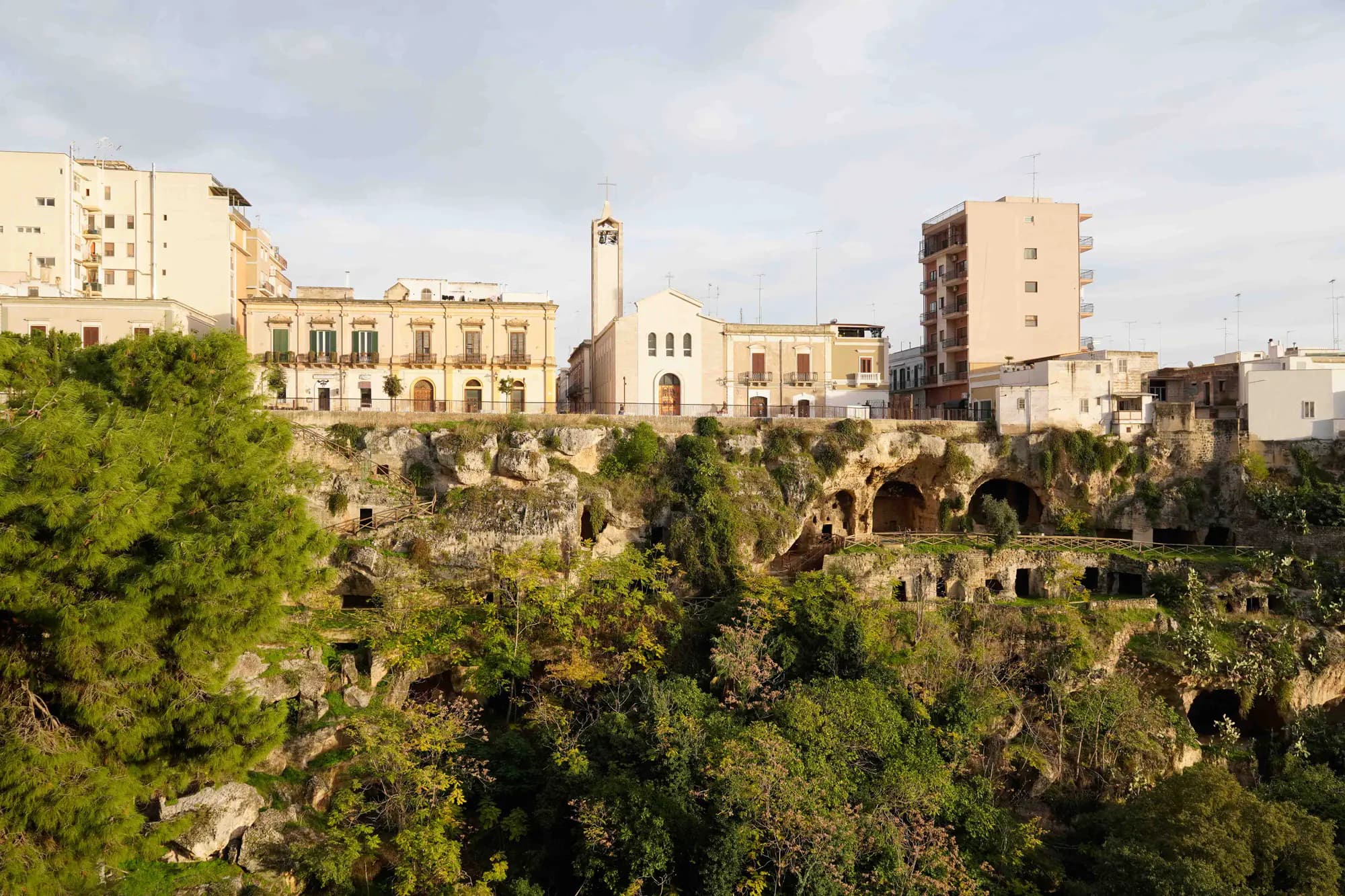
From the western rampart along which via Lo Pizzo runs, the eye crosses the void of the Gravina di San Marco – a gravina, or karst ravine – to rest on a spectacular layering of eras, architecture and faiths: a “vertical palimpsest” in which the modern town rises directly above the rock-cut civilisation. On the opposite wall lies the ancient settlement of Santa Marina. In use from the 8th to the 18th century, this imposing village is carved entirely into the rock and laid out in stacked terraces of cave houses, stables and workshops. At its heart is the monumental medieval church, a masterpiece of architecture “in negative”, enriched with frescoes and featuring three altars that bear witness to the centuries-long coexistence of the Greek and Latin rites.
In striking visual contrast, the church of Maria SS. del Carmine stands on the eastern edge of the ravine. The history of this church shows the ability of the Massafra community and its long-established Confraternity – founded in 1604 – to adapt to the great changes in the town’s layout. Its development falls into two key moments. The first dates from 1874–1875, when the confraternity’s old seat was demolished. Left without a place of worship, the group bought this plot on the edge of the ravine and began work on 16 March 1874; building progressed quickly, and on 18 July 1875 a small chapel was opened to meet the immediate needs of local residents.
The second phase came in the 20th century, when the relentless expansion of the town beyond the old core made the 19th-century building wholly inadequate. In January 1934 the church was made a parish and, around 1935, it underwent radical enlargement that extended its hall to its present size. The front took on its current gabled form, late neoclassical in inspiration and articulated by pilasters and narrow arched openings. Bridging past and present is the embossed iron and copper door of 1983, the work of the local sculptor Nicola Balestra, whose six panels depict the Marian dogmas and local identity. Two mirror-image worlds that, within a few metres of rock, hold a thousand years of history.
Images
Gallery
Information last checked: .